
How long will a 600 watt UPS last?
A 600W UPS backup time depends on battery capacity, voltage, and efficiency. Using the formula T = (C × V × η × K) / (P × COSφ), where C = battery capacity (Ah), V = battery voltage, η = inverter efficiency (~90%), K = discharge factor (0.7–1.0), P = load (600W), and COSφ = power factor (0.65–0.9). For example, a 48V 100Ah LiFePO4 battery with 90% efficiency provides ~53 minutes at full load. Pro Tip: Always derate calculations by 20% to account for aging and temperature effects.

What factors determine UPS runtime?
Battery capacity, load wattage, and inverter efficiency primarily dictate runtime. Higher Ah batteries and lower loads extend uptime, while poor efficiency (<85%) reduces it. For instance, doubling a 100Ah battery to 200Ah at 600W increases runtime from ~50 to ~100 minutes, assuming 48V and 90% efficiency.
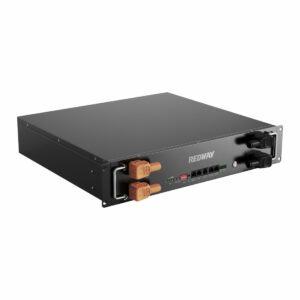
Runtime calculations require precise inputs: battery voltage (e.g., 12V, 24V, 48V), usable capacity (often 80% of rated Ah for lead-acid), and load power factor (0.65–0.9). Transitional systems like hybrid inverters may prioritize surge handling over runtime. Pro Tip: Use lithium batteries (LiFePO4) instead of lead-acid—they maintain 95% capacity after 2,000 cycles, unlike lead-acid’s 50% drop after 300 cycles. For example, a 5kWh 48V lithium pack supports a 600W load for ~7 hours versus ~3.5 hours with equivalent lead-acid.
How does battery voltage affect runtime?
Higher voltage systems reduce current draw, minimizing energy loss. A 48V battery at 600W draws 12.5A, while a 12V system pulls 50A—the latter loses 4x more energy as heat. This makes 48V/51.2V architectures ideal for mid-large UPS setups.
Consider two 1,200Wh systems: a 12V 100Ah battery vs. a 48V 25Ah. Despite equal energy, the 48V system lasts longer due to lower resistive losses (I²R). Transitionally, high-voltage designs also allow thinner cables—saving space and cost. Real-world example: A 600W server on a 24V 200Ah lead-acid battery runs ~3.2 hours, whereas a 48V 100Ah LiFePO4 lasts ~4.1 hours. Pro Tip: Match battery voltage to UPS input specs—mismatches require DC-DC converters, wasting 5–15% efficiency.

| Voltage | Current at 600W | Typical Runtime* |
|---|---|---|
| 12V | 50A | 1.6h |
| 24V | 25A | 3.3h |
| 48V | 12.5A | 6.7h |
*With 100Ah battery, 90% efficiency
RackBattery Expert Insight
FAQs
Can a 600W UPS run a refrigerator?
Yes, but only briefly—most full-size fridges require 1,200+ startup watts. Use a UPS with surge handling ≥1,800W and ≥200Ah battery for 30+ minute runtime during outages.
How to increase UPS runtime?
Parallel additional batteries or upgrade to higher Ah capacities. For a 600W load, adding a 48V 50Ah battery extends runtime by ~40 minutes (assuming 90% efficiency).
